
Tile Roof Underlayment Replacement in San Diego: What to Know

If your San Diego home has a tile roof that’s 20 years old or more, the tiles are probably fine. The layer underneath them may not be. That layer is the underlayment, and it’s the most common reason tile roofs leak in San Diego.
Here’s what underlayment does, how to tell when it’s worn out, and what replacing it involves.
What Is Tile Roof Underlayment?
Underlayment is the waterproof layer installed on the roof deck, under the tiles. Tiles shed most of the rain, but water still gets between and under them, especially in wind-driven storms. The underlayment is what keeps that water out of your home.
Older roofs usually have felt underlayment. Newer roofs often use synthetic underlayment, which holds up better to heat.
How Long Does Underlayment Last?
In San Diego, tile roof underlayment typically lasts 20 to 30 years. Concrete and clay tiles can last 50 years or more. That gap is why so many San Diego homes have tiles that look fine from the street and a waterproof layer underneath that is worn out.
Heat speeds things up. Inland homes in places like Santee, El Cajon and Poway see long, hot summers that dry out and crack felt underlayment faster than at the coast.
Signs Your Underlayment Needs Replacing
- Leaks or ceiling stains, especially after the first big rain of the season
- Your tile roof is 20 years old or more and has never had the underlayment replaced
- Leaks that come back after the tiles have been repaired
- Damp or stained roof decking visible from the attic
- Cracked or slipped tiles that have let sun and water reach the underlayment
You can’t see underlayment from the ground. A roofer checks it by lifting tiles in a few spots and looking at the decking from the attic. Our roof inspections are free.
How Underlayment Replacement Works
Roofers often call this a “lift and relay” or “R&R.” It usually goes like this:
- Remove the tiles and stack them on the roof or the ground.
- Remove the old underlayment and check the wood decking underneath, replacing any damaged sections.
- Install new underlayment, plus new flashing where needed around chimneys, vents, skylights and walls.
- Reinstall the original tiles, replacing any that are broken with the closest match available.
Because you keep your existing tiles, this usually costs less than a full tile roof replacement, and your home keeps the same look.
Can All the Tiles Be Reused?
Most can. Some tiles always break during removal, and some may already be cracked. We replace those with the closest match available. If your tile style is discontinued, we’ll show you the options before work starts.
Frequently Asked Questions
How long does an underlayment replacement take?
It depends on the size of the roof. A typical home takes about a week, and the weather can affect the schedule.
Can you replace the underlayment on just part of the roof?
Sometimes. If one section is worn and the rest is in good shape, a partial replacement can make sense. If the underlayment is the same age everywhere, it’s usually better to do the whole roof.
Is underlayment replacement the same as a new roof?
Not quite. You get a new waterproof layer and new flashing, but you keep your existing tiles. It’s often the best value for a tile roof with good tiles.
Get Your Tile Roof Checked
Top Flight Roofing has repaired tile roofs across San Diego County since 2000 (CA License #1146267), and our work is backed by our 10-year workmanship guarantee. Learn more about tile roof repair or roof replacement. Call 619-562-6453 or book online.
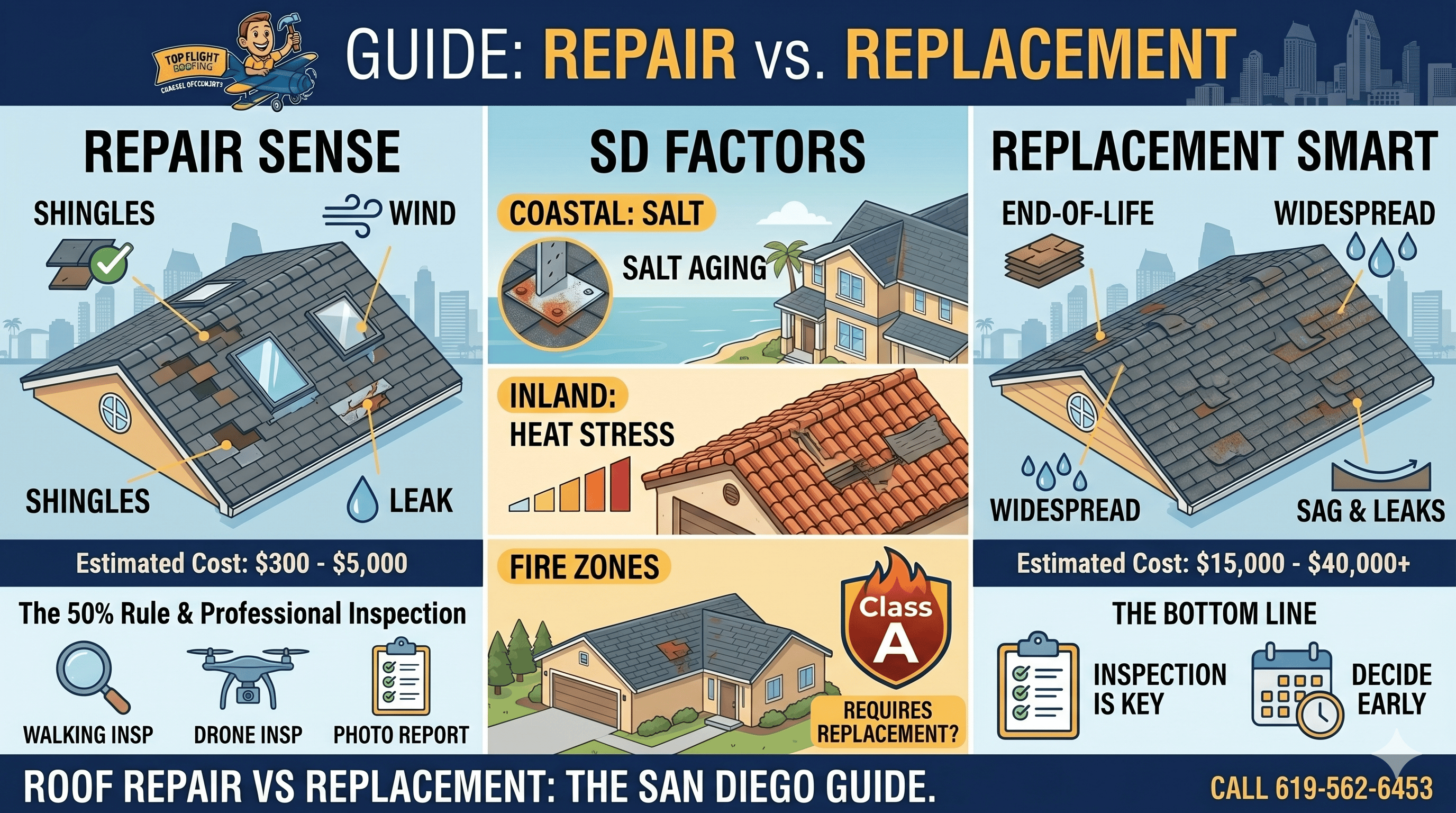
Frequently Asked Questions: Roof Repair Vs Replacement
Can I just patch one section of my roof?
Yes, if the damage is truly isolated and the rest of the roof is in good condition. The challenge is that what looks like one bad section often hides issues elsewhere. A thorough inspection determines whether patching is the right approach or just a temporary fix.
How do I know if my roof is at end-of-life?
Common signs include widespread granule loss (you'll see granules in your gutters), curling or cracking shingles, sagging in any area, multiple leaks over time, and roofs that simply look "tired" from the street. If your roof is 20+ years old and showing any of these signs, replacement is likely the right call.
Will a new roof actually increase my home value?
Possibly, a new roof typically adds significant value to a San Diego home, both in actual sale price and in how quickly the home sells. Many buyers won't even consider homes with obviously aging roofs because of the immediate replacement cost they'd face.
How quickly do I need to decide?
If you have an active leak, the answer is immediately. If you're seeing aging but no leaks, you have time to plan but shouldn't wait until winter rains arrive. The best time to replace a roof in San Diego is late spring through early fall, when the weather is most predictable.

More Articles

Roof Repair vs Replacement: Which Saves You More Money?
Replacing a Roof With Solar Panels in San Diego: What to Know
Tile Roof Underlayment Replacement in San Diego: What to Know

Phone Number:
619-562-6453Address: 9510 Cuyamaca St STE 101, Santee CA 92071